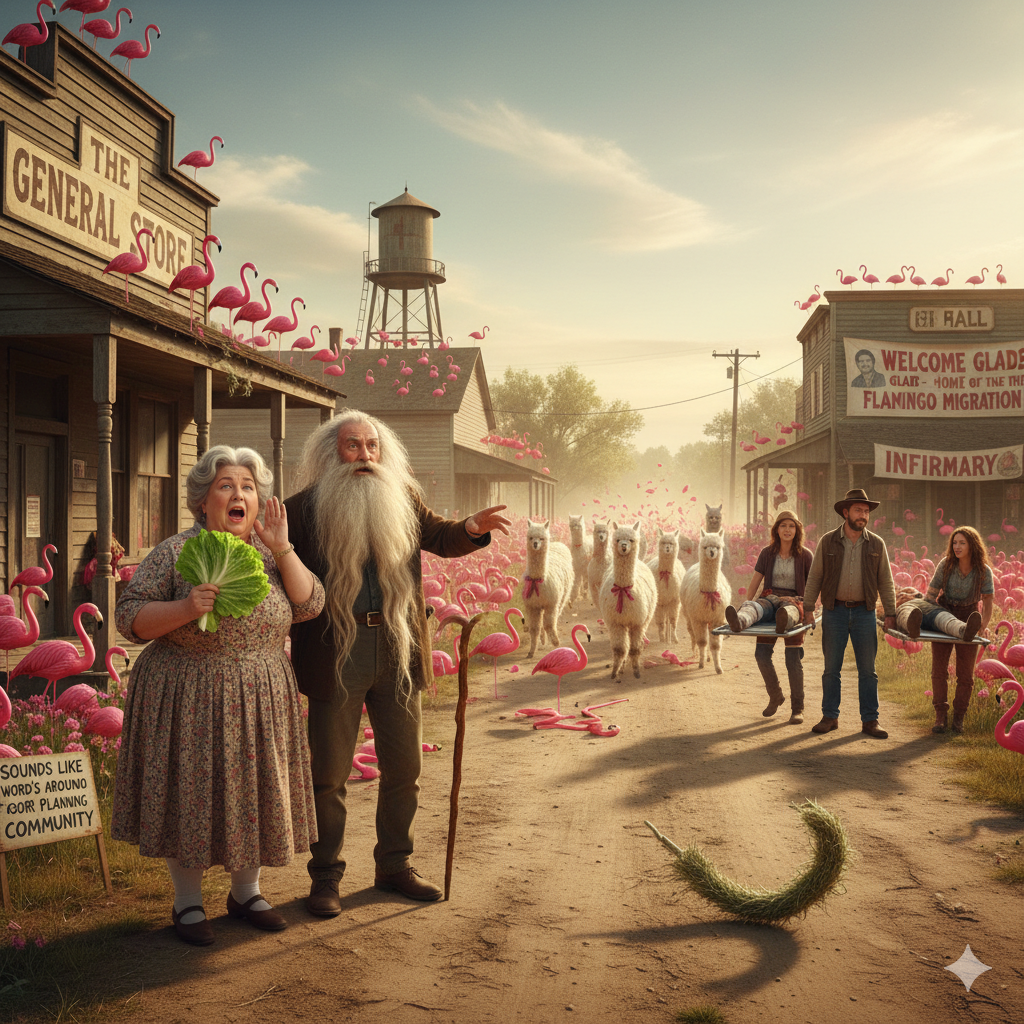
The afternoon sun beat down on the dusty main street of Harmony Glade, a town that, despite its name, was anything but harmonious. A tumbleweed, the unofficial mascot of poorly thought-out decisions, bounced lazily past the general store, where a group of townsfolk had gathered. Their faces, usually etched with the weariness of constant “oopsie-daisies” and “well, we didn’t think of that,” were now animated with a strange mix of disbelief and morbid fascination.
“Did you hear?” whispered Ma Jenkins, fanning herself with a wilting lettuce leaf, “Sounds like word’s getting around in the poor planning community.”
Old Man Fitzwilliam, whose beard was almost as long as his list of grievances against the town council, grunted. “About time. Though I reckon they’re the ones who started the community in the first place.”
The latest catastrophe to befall Harmony Glade was the “Great Flamingo Migration.” Mayor Mildred McMillan, in an attempt to boost tourism (and her re-election chances), had ordered a thousand plastic flamingos to be placed strategically around town. Her vision: a vibrant, quirky paradise. The reality: a gaudy, tripping hazard-filled nightmare that had already sent three citizens to the infirmary and caused a stampede of Mrs. Gable’s prize-winning alpacas.
A new sign, hastily erected near the general store, proclaimed in crooked letters: “SOUNDS LIKE WORD’S GETTING AROUND IN THE POOR PLANNING COMMUNITY.” It was unclear who put it there, but everyone suspected young Timmy, the sarcastic stable boy.
Inside the Mayor’s office, Mildred, a woman whose enthusiasm consistently outstripped her foresight, was poring over blueprints for her next grand scheme: a “synchronized firefly show” to be performed over the town’s highly flammable wooden bridge.
“It’ll be magnificent, Jenkins!” she declared to her long-suffering assistant, who was attempting to pry a plastic flamingo off his shoe. “Imagine! Thousands of blinking lights! A true spectacle!”
Jenkins merely sighed, envisioning the inevitable blaze. “Mayor, about the bridge… and the fireflies… are they… safe together?”
“Nonsense!” Mildred waved a dismissive hand, narrowly missing a stack of unread safety reports. “What could possibly go wrong?”
Meanwhile, outside, a grizzled prospector named Silas, who had arrived in Harmony Glade years ago hoping to strike it rich (and instead found only an abundance of poorly maintained infrastructure), was muttering to himself. He’d just heard about the firefly plan.
“Poor planning community, eh?” he chuckled, spitting a stream of tobacco juice. “They ain’t seen nothin’ yet. Just wait till they try to build that ‘solar-powered’ outhouse on the north side of the mountain where the sun don’t shine.”
As the sun began to set, casting long, dramatic shadows over the flamingo-infested town, a dusty old wagon pulled up to the edge of Harmony Glade. A man with a clipboard and a weary expression stepped out. He looked around at the chaos – the flamingos, the fleeing alpacas, the sign about poor planning.
He pulled out a small notepad. “Right,” he muttered to himself. “Another site visit for the ‘Global Institute of Inefficient Urban Design.’ Looks like we’ve got a new contender for the ‘Most Enthusiastic Yet Utterly Incompetent Municipal Planning’ award.”
He took a deep breath, and then, with a shake of his head, walked into the heart of Harmony Glade, ready to document the latest, greatest examples of the poor planning community’s enduring legacy. And somewhere, a thousand plastic flamingos stood testament to the fact that, yes, word was definitely getting around.
I work at a grocery store in the floral department. There is a prom this Saturday, and it’s right before Mother’s Day, so things are pretty swamped at work right now. We only have one person who is a designer to make all of the hand-held bouquets, corsages, and boutonnieres. We aren’t taking any more orders for prom; we have too many for one person to do.
A customer in her forties or fifties comes in.
Customer #1: “I need a corsage with a black ribbon. It’s for my mother for Mother’s Day, but I need to pick it up on Saturday.”
Sadly for us, we do take the order for Saturday.
My coworker and I talk about it after she leaves, and we reach the conclusion that it’s actually a prom order. It tips us off that she asked for a black ribbon — for a mother on Mother’s Day, it should be a bright, almost pastel color, not black — and that she wanted to pick it up on Saturday instead of Sunday.
[Coworker] and I agree that Mother’s Day order pick-up will have to be Sunday because we already have too many orders scheduled for pick-up on Saturday.
About two minutes before I get off, we get a call. Before I answer, [Coworker] says:
Coworker: “I’ll bet they’re looking for a ‘Mother’s Day’ corsage, but they want to pick it up on Saturday.”
I answer the phone.
Customer #2: “I need a corsage for Mother’s Day, but I need to pick it up on Saturday.”
[Coworker] freaking called it!
Me: “I’m sorry, but Mother’s Day pick-up has to be on Sunday.”
Customer #2: “Oh. Okay.”
And they hung up. (I always wait for the customer to hang up first, just in case they still need something.)
Moral of the story: don’t order flowers last minute, especially during busy seasons and holidays.
credit
